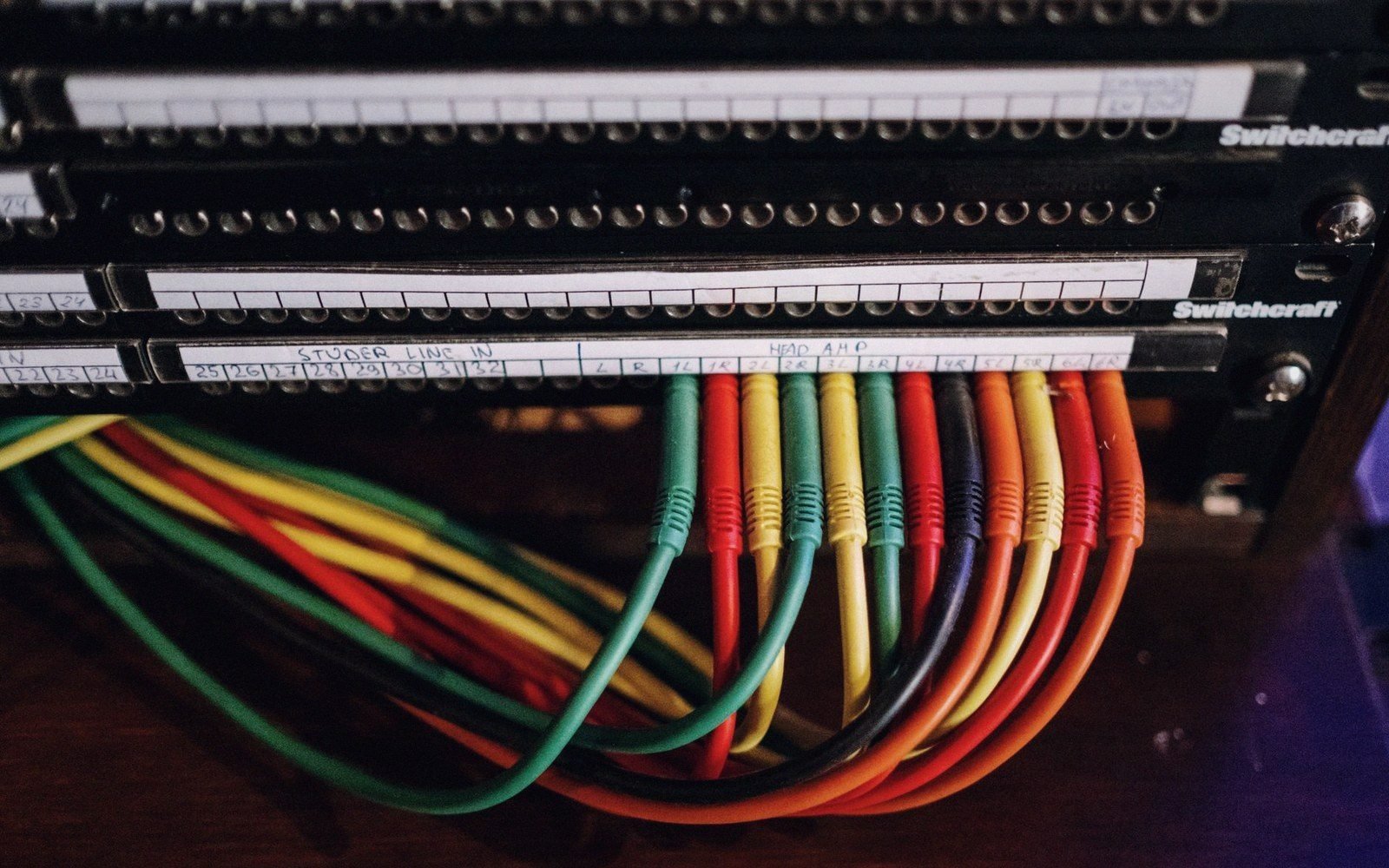
Getting Signal Where It Needs to Go
A patchbay is a panel of sockets — typically 48 or 96 TRS or TT (tiny telephone, also called bantam) jacks — wired so that every input and output in a rig terminates at one reachable surface. Without one, rerouting a Roland TB-303 through a different effects unit means crawling behind a desk. With one, it means pulling one patch cable.
The critical concept is normalisation. In a normalised patchbay row, the top socket (usually an output) connects automatically to the bottom socket (usually an input) when nothing is plugged in. Inserting a patch cable at either point breaks that connection and redirects signal. Half-normalisation breaks the connection only when something is plugged into the bottom row, leaving the top row active — useful for parallel processing, where you want to split a signal to two destinations simultaneously without a splitter cable.
For a bedroom producer in the early 1990s running a sampler, a drum machine, a 303, and two effects units, the economics were blunt. A basic 48-point TRS panel cost a fraction of a TT patchbay from a pro-audio supplier, and a standard 19-inch rack strip could be mounted in a shelving unit if no proper rack existed. The wiring itself — soldering every piece of outboard's ins and outs to the rear of the panel — was a half-day job done once, saving hours across every subsequent session.
The practical minimum: route all outputs top row, all inputs bottom row, normalised in matched pairs. Effects units sit between sends and returns. If your mixer lacks aux sends — common with cheap live-sound desks pressed into studio duty — the patchbay compensates by letting you intercept any signal path at will. That flexibility, not any sonic quality of the patchbay itself, is the point.