The Lathe and the Cutter Head
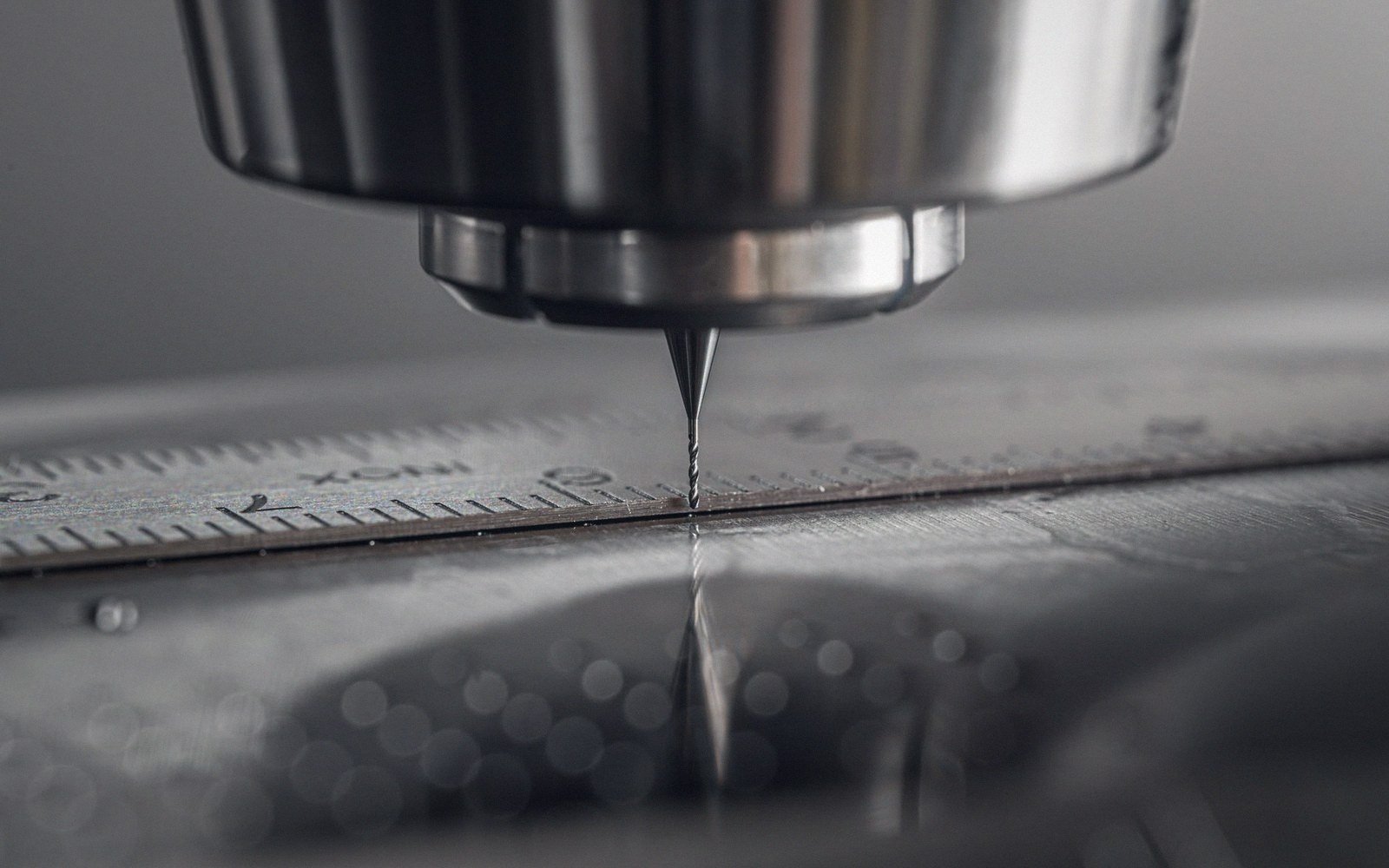
A disc-cutting lathe is a precision machine — the two most common in British mastering rooms were the Neumann VMS-70 and VMS-80, though older Scully and Ortofon lathes stayed in service at smaller facilities well into the 1990s. The business end is the cutter head: a device containing a pair of coils mounted on a cantilever, energised by amplified audio signal and driving a sapphire or ruby stylus through a lacquer-coated aluminium disc at a controlled feed rate. The lacquer itself is a nitrocellulose coating applied to a 14-inch aluminium blank; the stylus cuts a groove into it rather than pressing or burning — it is mechanical engraving at very fine tolerances.
The groove carries two channels of audio in a 45/45 configuration: each side wall corresponds to one channel, with lateral movement carrying the sum of left and right and vertical movement carrying the difference. A mono signal cuts a purely lateral groove; a heavily out-of-phase stereo signal cuts a heavily vertical one. Excessive vertical motion is a problem — it can cause the stylus to jump out of the groove on playback, which is why cutting engineers pay close attention to the stereo difference signal, particularly in bass frequencies where the energy is highest.
What the Engineer Actually Controls
The cutting engineer is not running a simple transfer. Three variables — level, pitch, and EQ — are under active control throughout the cut, and each has audible consequences in the pressing.
Level is the amplitude of the groove modulation. Cutting louder makes wider groove excursions, which demands more space per revolution and limits total programme time. Cutting too loud on peaks causes intermodulation between adjacent groove walls — a phenomenon audible as a kind of fuzzy sibilance or low-level distortion. Most engineers run a preview pass, feeding the signal through a pitch computer a few seconds ahead of the cutting stylus so the lathe can respond to incoming dynamics before they arrive.
A phono preamplifier applies the inverse curve on playback, restoring flat frequency response.
Pitch — here meaning the distance between grooves rather than audio pitch — is varied continuously on a modern lathe via that same preview delay. Louder or more dynamically complex passages get wider pitch spacing; quieter passages are cut closer together. This variable-pitch system is what allows twelve minutes of music onto a 12-inch side without either sacrificing level or risking groove collision. On a static-pitch cut, the engineer has to set the spacing conservatively for the loudest moment and accept reduced level everywhere else. Variable pitch was standard on Neumann-equipped rooms; it is one reason the VMS-80 became the machine of choice for high-volume dance mastering.
EQ at the cutting stage is applied partly for technical necessity and partly for aesthetics. RIAA equalisation is applied as a standard: bass is attenuated before cutting (to keep groove width manageable) and treble is boosted (to keep the signal above the noise floor of the groove surface). A phono preamplifier applies the inverse curve on playback, restoring flat frequency response. On top of this, cutting engineers routinely apply their own EQ — adding top-end air, tightening sub-bass, pulling down a resonant mid. Some of this corrects problems in the master; some of it reflects the sonic character of a particular room and engineer.
Bass, Phase, and the Dance Floor
For dance music specifically, the treatment of low frequencies at the lathe is where pressings diverge most dramatically. Deep sub-bass below 80 Hz is frequently summed to mono before cutting — this reduces vertical groove modulation and allows the level to be maintained. Whether that summing happens at a fixed frequency or on a dynamic basis, and how transparently it is done, is an engineering choice. Handled badly, it narrows the stereo image of a kick drum or bassline in a way that is immediately audible on a good system.
The relationship between the master tape — or, from the early 1990s onwards, DAT — and the lacquer is not a straight line. A cutting engineer working in a room like The Exchange in London, or Porky's Mastering (known for the hand-etched messages in the dead wax), or Transition Audio in Bristol, brought their own preferences and the character of their equipment to every cut. The dead wax — the silent area between the last groove and the label — often carries a hand-etched matrix number and sometimes an engineer's personal mark: a small circle, initials, a phrase. These marks are a record of who cut the disc and on what machine, as legible to collectors as a catalogue number.
Once the lacquer is approved, it goes to the plating facility. There it is silverised, electroplated to create a metal negative (the "father"), and from that a series of further generations are made before the stampers that actually press vinyl are produced. The lacquer itself is consumed in the process. What survives is the impression it left.